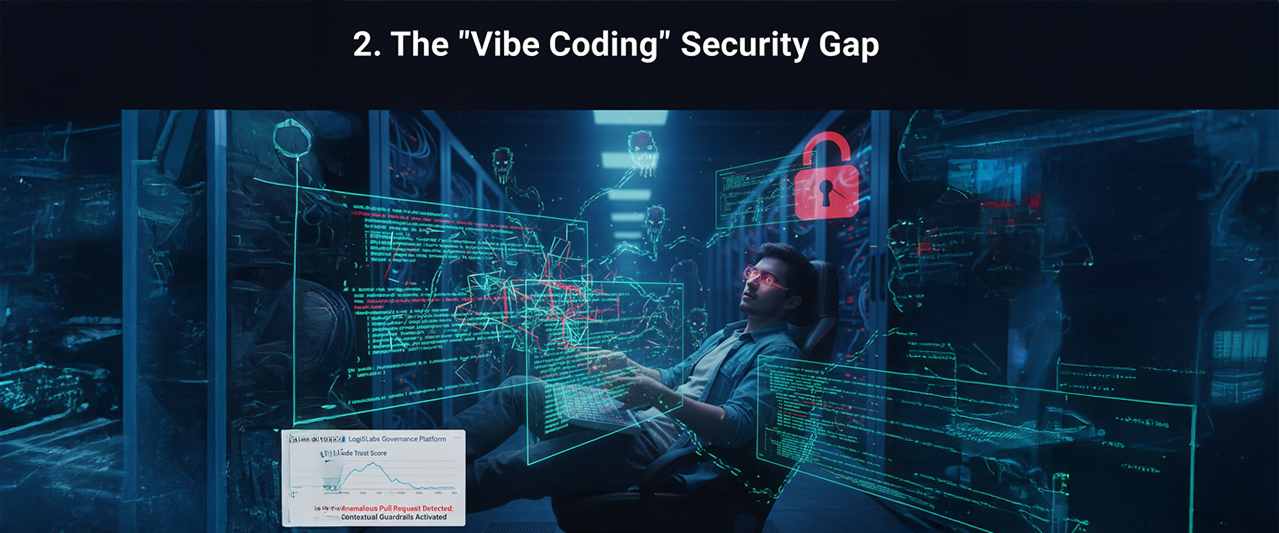
I. The Problem: The Velocity-Security Paradox
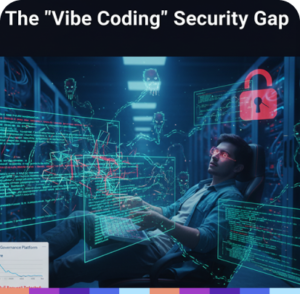
Vibe coding collapses the traditional Software Development Life Cycle (SDLC) from months into minutes. However, this speed comes with three critical security failures:- Slopsquatting & Dependency Hallucination: AI models frequently suggest non-existent libraries or “hallucinated” packages. Attackers are now “slopsquatting”—registering these hallucinated names with malicious code. In 2025, over 200,000 hallucinated packages were identified as potential entry points for supply chain attacks.
- The “Silent” Logic Flaw: Unlike traditional bugs, vibe-coded errors are often syntactically perfect but semantically disastrous. We see AI-generated authentication logic that defaults to “True” on error, or “forgot password” functions that inadvertently leak user emails due to inconsistent object referencing.
- Contextual Blindness: LLMs generate code in a vacuum. They might suggest a high-performance database query that lacks the specific access control filters required by your organization’s internal data sovereignty policies.
II. The Solution: Beyond Static Scanning
In the era of natural language development, a weekly security scan is a relic. The enterprise requires Continuous, Agentic Governance.- Prompt-Level Guardrails: Governance must start at the ‘prompt’ not the ‘pull request’. By enforcing structured “Prompt Requirements Documents” (PRDs), organizations can force AI to include security headers, input sanitization, and cryptographically secure randomness by default.
- The “Autonomous Peer Reviewer”: We must fight AI with AI. Enterprises are deploying “Shadow Agents” whose only job is to provide a hostile, security-focused review of every vibe-coded snippet before it is committed to a repository.
- Verification of Intent: Governance platforms must move from “Does this code run?” to “Does this code do exactly—and only—what was intended?” This requires a mapping of business intent to code execution.
III. Logi5Labs: The “Contextual Immune System” for Your Codebase
Logi5Labs doesn’t just scan code; it governs the ‘relationship’ between the developer’s intent and the AI’s output. We act as the Hard Governance Layer for the Vibe Coding era.- Automated Dependency Verification: Logi5Labs automatically cross-references every AI-suggested package against global registries and internal “Allowed Lists.” If an AI suggests a “slopsquatted” package, the system kills the pull request before it hits the build pipeline.
- Policy-as-Code Enforcement: We translate your CISO’s high-level security policies into real-time filters. If an AI agent attempts to write a vibe-coded function that accesses sensitive PII without an encrypted token, Logi5Labs blocks the action and provides the developer with the secure code alternative.
- The “Black Box” for Vibe Coding: Logi5Labs maintains an immutable record of the natural language prompts and the resulting code. This provides the “Why” behind the “What,” ensuring that even when developers don’t read the code, your auditors can.