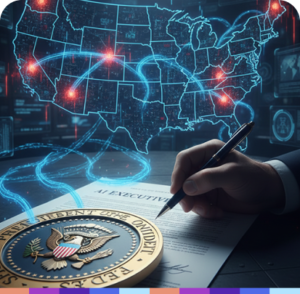

I. The Problem: A Federal Handshake with a State Shakedown
The new Executive Order signals a “light-touch” federal approach designed to foster innovation. However, states like California, Colorado, and New York have already begun to advance their own comprehensive AI safety and bias accountability laws. This creates an immediate “pre-emption paradox”:- Legal Fragmentation Intensified: Instead of clarifying the landscape, the EO introduces a new layer of legal ambiguity. Enterprises must now contend with federal guidance that may conflict with, or seek to nullify, stricter state mandates – creating a legal tug-of-war that exposes companies to compliance risk from multiple angles.
- Operational Drag: Each day, legal teams are scrambling to interpret the implications of new state bills and federal guidance. This manual, reactive process slows AI deployment, increases legal costs, and creates a significant drag on innovation velocity as product teams wait for clarity.
- The Compliance Gap: Without a clear, unified framework, organizations risk unknowingly violating either federal or state requirements, leading to potential fines, reputational damage, or even forced suspension of AI initiatives in specific jurisdictions.
II. The Solution: Dynamic, Jurisdictional Policy Enforcement
In this volatile regulatory environment, relying on static legal interpretations is a recipe for disaster. Enterprises need a proactive solution: Dynamic, Jurisdictional Policy Enforcement.- Intelligent Regulatory Mapping: A system must exist that can ingest new federal EOs and state bills in real-time, mapping their specific requirements (e.g., bias testing thresholds, data provenance rules) to the operational AI pipeline.
- Granular Geographic Controls: AI deployments need the ability to adapt their behavior based on the specific legal and regulatory conditions of the jurisdiction in which they operate. An agent operating in California might face different bias testing requirements than one in Texas.
- Automated Policy Translation: Legal guidelines must be automatically translated into machine-executable rules that govern the AI’s data access, model training, and deployment behavior – ensuring compliance without human bottlenecks.
III. Logi5Labs: The Agile Compliance Layer for the Federated Enterprise
The challenge of the federal pre-emption battle is not just legal – it’s technical. Logi5Labs provides the essential Agile Compliance Layer that sits between dynamic legal mandates and your operational AI systems.- Real-time Regulatory Integration: Logi5Labs’ platform is designed to ingest and interpret new regulatory inputs (federal EOs, state legislation) as they are released. It dynamically updates your policy catalog, ensuring your compliance posture is always current, not reactive.
- Jurisdiction-Specific AI Guardrails: Logi5Labs enables you to define and enforce geographic-specific policy-as-code. This means your AI agents automatically adhere to the correct federal or state mandates based on their operational location or the data they are processing, ensuring “localized compliance at global scale.”
- Unified Regulatory Audit Trail: The platform provides a single, immutable audit log that demonstrates precisely how each AI decision or deployment complied with the relevant federal and state regulations, providing irrefutable proof for legal teams and auditors.