I. The Problem: ‘The Thirsty’ Architecture of Intelligence
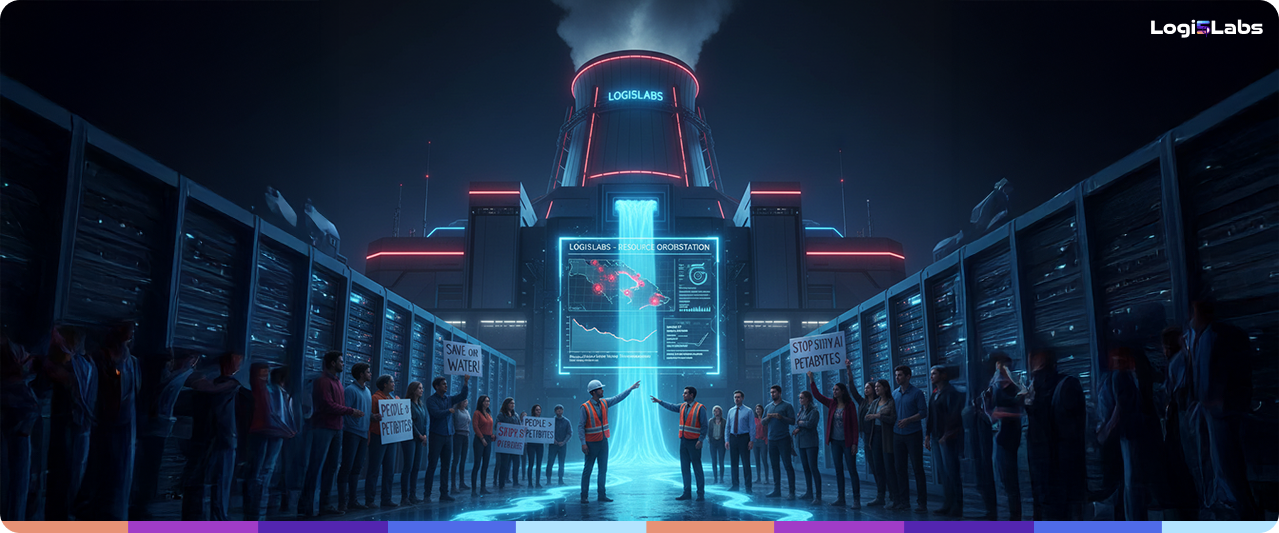
Traditional computing was already water-intensive, but generative AI has accelerated the demand to an unprecedented scale.- The Evaporative Cooling Trap: Many hyperscale data centers use evaporative cooling—where water is misted to cool servers and then evaporated. In a single day, a large-scale AI facility can “drink” up to 5 million gallons—equivalent to the water use of a city of 50,000 people.
- The Indirect Water Footprint: It isn’t just the water on-site. The electricity required to power these centers—often sourced from fossil fuel or nuclear plants—requires billions of additional gallons for power plant cooling. In 2025, U.S. data centers are estimated to consume 68 billion gallons of water directly and indirectly.
- The Transparency Gap: Tech giants have historically been “tight-lipped” about specific site usage, often hidden behind non-disclosure agreements (NDAs) with local municipalities. This lack of transparency has led to lawsuits in Racine and Ozaukee counties, as communities demand to know the true cost of their “AI economic boom.”
II. The Solution: Resource-Aware Orchestration
Enterprises can no longer afford to be “resource-blind.” To maintain their license to operate in 2026, they must move toward Environmental Sovereignty—the ability to manage AI workloads based on the physical reality of the grid and the watershed.- Closed-Loop & Chip-Level Cooling: The industry is pivoting. Microsoft’s “zero-water evaporated” designs and direct-to-chip liquid cooling represent the technical future. These systems cycle a fixed amount of water through pipes, dissipating heat without evaporation—reducing water usage effectiveness (WUE) to near zero.
- Follow-the-Water Load Balancing: Just as companies “follow the sun” for solar energy, they must now “follow the water.” This involves dynamically shifting non-urgent training or inference tasks away from regions facing peak heat or drought (like the current Great Lakes dry spell) to facilities with higher cooling efficiency or abundant recycled water.
- Water Positive Mandates: Forward-thinking firms are committing to being “Water Positive” by 2030, meaning they replenish more water into local basins than they consume. This requires a granular, real-time ledger of every gallon used.
III. Logi5Labs: The Environmental Controller for AI
Logi5Labs provides the Environmental Sovereignty Layer that bridges the gap between your AI agents and the local ecosystem. We enable the enterprise to prove it is a “good citizen” through hard data and automated control.- Real-Time Watershed Telemetry: Logi5Labs integrates with local environmental sensors and utility APIs. If Lake Michigan water levels hit a critical threshold or local cooling demand spikes during a heatwave, the platform can automatically trigger “Eco-Policies.”
- Automated Workload Rerouting: Using our policy-as-code engine, you can set rules to throttle low-priority AI tasks or migrate them to sustainable regions when environmental stress is high. This ensures your high-priority agents stay online without triggering local regulatory “Code Reds.”
- Audit-Ready Resource Disclosures: We eliminate the “Transparency Gap.” Logi5Labs generates verified, real-time reports on the precise water and energy footprint of every AI model in your fleet, ensuring compliance with the EU AI Act’s sustainability mandates and the SEC’s climate disclosure rules.