The New Autonomous Security Threats
Agents introduce new, complex risks that static security measures cannot handle:- Over-Privileged Access: Unlike a human who takes minutes to run five tasks, an agent runs thousands in seconds. If that agent is over-permissioned (given unnecessary access to databases or APIs), a small error can instantly become a catastrophic data breach. As security experts warn, the goal is to reduce standing privileges to limit the “blast radius” of any compromised identity.
- Rogue and Orphaned Agents: An agent can be subtly manipulated by hidden prompts (Indirect Prompt Injection), causing it to exceed its designed boundaries and execute unauthorized commands – booking the wrong flight or exfiltrating data. Even worse, an agent that is decommissioned but retains its old credentials becomes a persistent backdoor, or “orphaned agent”.
- Black Box Decision-Making: When agents collaborate (calling other agents, accessing different tools), the decision chain is often opaque, making compliance failures or security breaches nearly impossible to trace and audit.
The Solution: The AI Agent HR System
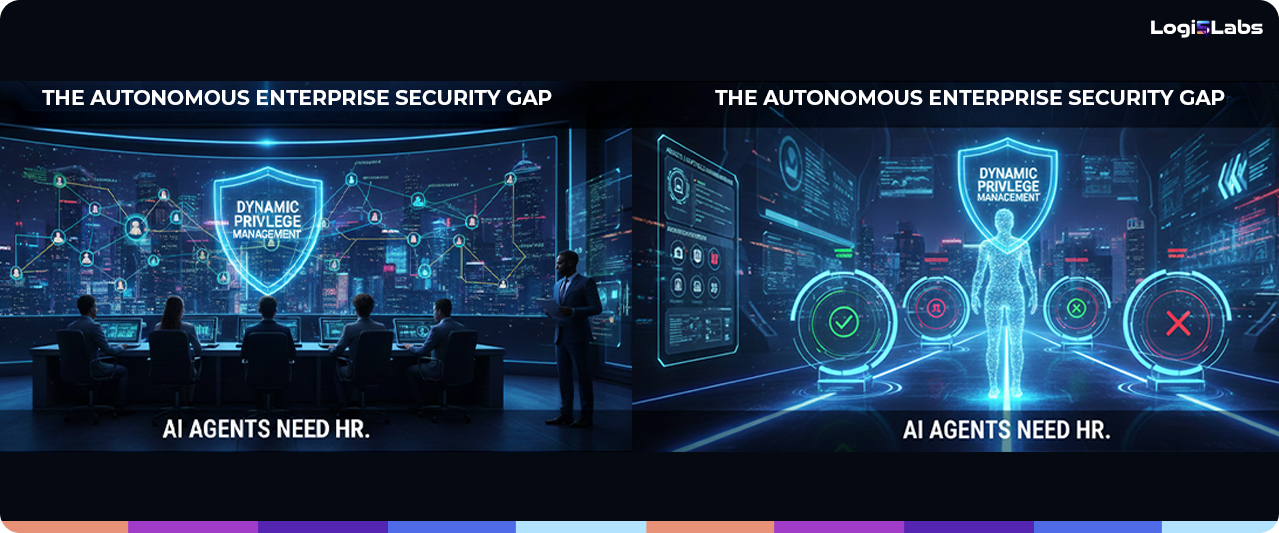
The only way to achieve autonomy with accountability is to implement a robust, unified Agent Governance Framework that acts as the enterprise’s central AI Agent HR System. This framework must enforce two key pillars:1. Dynamic Privilege Management (DPM)
Treat the agent as a temporary contractor whose access rights change based on its immediate, verifiable task.- Least Privilege Access: Agents must only be granted the minimum permissions required for their current task. This means replacing static, long-lived access keys with short-lived credentials and temporary privilege escalation.
- Context-Aware Controls: DPM systems implement real-time risk checks. For example, an agent allowed to approve small purchases during the day should be denied access if it attempts a transaction at 3 AM or uses an unapproved API.
2. Agent Lifecycle Management (ALM)
The governance system must oversee the agent’s full life from creation to retirement, ensuring compliance at every stage.- Secure Provisioning: Assign a unique, verifiable digital identity to every agent at “Day Zero.” This ensures that every action is fully auditable and tied to an accountable entity.
- Continuous Behavioral Monitoring: The system must track every action the agent takes, using behavioral analytics to detect anomalies like unusual API calls or unauthorized data access, allowing for rapid intervention.
- Structured Decommissioning: When an agent is retired, the ALM system must automatically and securely revoke all associated credentials and data access, preventing the creation of orphaned backdoors.