I. The Compliance Equation is Broken
Enterprises are facing an unmanageable compliance burden due to fundamentally divergent global philosophies:- The EU’s Precautionary Approach: The EU AI Act prioritizes citizen rights and safety through a risk-based framework that mandates strict pre-market conformity assessments and detailed documentation for “High-Risk” systems. Penalties are severe, reaching up to €35 million or 7% of global revenue.
- The US’s Sectoral Deregulation: US policy focuses on accelerating innovation, relying on existing sectoral laws (finance, healthcare) and executive guidance for post-deployment testing and transparency. This creates a patchwork of state-level laws that can even introduce conflicting rules.
- Sectoral Overlap and Audit Fatigue: Even within a single jurisdiction, an AI system used in healthcare must comply with the EU AI Act and GDPR, leading to redundant documentation and audits that drastically slow down time-to-market and accelerate development costs.
II. The Solution: Compliance-as-Code for the Global Enterprise
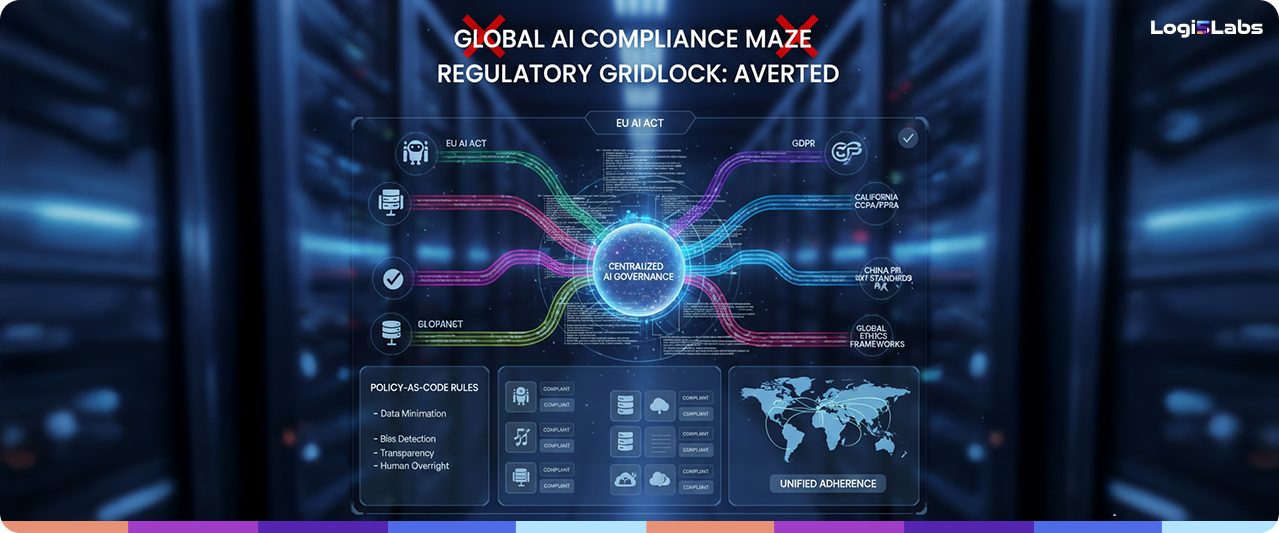
Compliance can no longer be a text document; it must be executable code. Policy-as-Code is the only infrastructure capable of automatically managing this scale and complexity. PaC transforms legal requirements into machine-readable rules that are automatically enforced across the AI lifecycle – from data ingestion to model deployment. This approach shifts governance from a delay mechanism to a technical enabler.- Unified Risk Taxonomy: The PaC system must ingest all global and sectoral rules and establish a single, universal risk classification. An agent’s action is governed by the most stringent rule set from all applicable jurisdictions (e.g., if used in a US-regulated financial context and impacting an EU citizen, both rule sets are enforced).
- Automated Policy Mapping: A requirement like “High-Risk systems must have human oversight” is mapped directly to a technical constraint: Policy code blocks the model’s output in sensitive decisions until a validated human supervisor approves the step, automatically generating an auditable log.
- Shift-Left Compliance: Compliance checks are moved into the development pipeline (CI/CD) where they prevent violations instantly, rather than costly remediation after deployment.
III. Logi5Labs: The Global Regulatory Operating System
The Regulatory Fragmentation Crisis is a direct threat to global scaling, but it is a monumental opportunity for the right governance platform. Logi5Labs’ Governance Platform is the Global Regulatory Operating System for AI. It provides the central intelligence required to move beyond manual, country-by-country compliance:- Execute Global Policy Locally: Logi5Labs allows the C-Suite to define a single, global set of AI principles and automatically translate them into granular, locale-specific enforcement policies that govern the agent’s actions in real-time, regardless of the compute environment (cloud or on-premise).
- Cross-Jurisdictional Audit Trails: The platform provides a unified audit log and a Machine Learning Bill of Materials (ML-BOM) for every AI action. This log can be filtered instantly to generate a compliance report for any single regulation (EU AI Act, HIPAA, etc.), eliminating the massive administrative burden of duplicate documentation.