The Inference Tsunami: Why Cloud-First AI is Broken and Hybrid Architecture is the Only Path to Profitability

The core assumption that has driven IT for a decade – that the cloud is always the answer – is failing under the weight of AI. As the AI Agent workforce scales, the financial reality of Inference Costs is forcing a massive and immediate reckoning with enterprise infrastructure strategy. The era of the simple “cloud-first” strategy for AI is over. I. The Cloud Tipping Point: Drowning in Inference Costs The financial model of AI is paradoxical. While the cost of running a single AI inference (using a model) has dropped significantly, the volume of continuous, autonomous usage is growing far faster. This imbalance has created the “Inference Tsunami.”
  • Explosive OpEx: Autonomous agents require constant, continuous inference, sending cloud token and usage costs spiraling. For high-volume users, relying solely on public cloud providers is now an exponential expense, leading some CFOs to face multi-million dollar bills for AI use alone.
  • The 60% Rule: For predictable, high-volume AI workloads, many organizations are realizing they have crossed the cloud tipping point. When continuous operational expenses (OpEx) surpass 60% to 70% of the capital expenditure (CapEx) of a private data center equivalent, the financial mandate swings decisively toward owning the infrastructure. Hybrid models offer TCO savings that can be 2x–3x more efficient than continuous public cloud use over a five-year lifespan. 
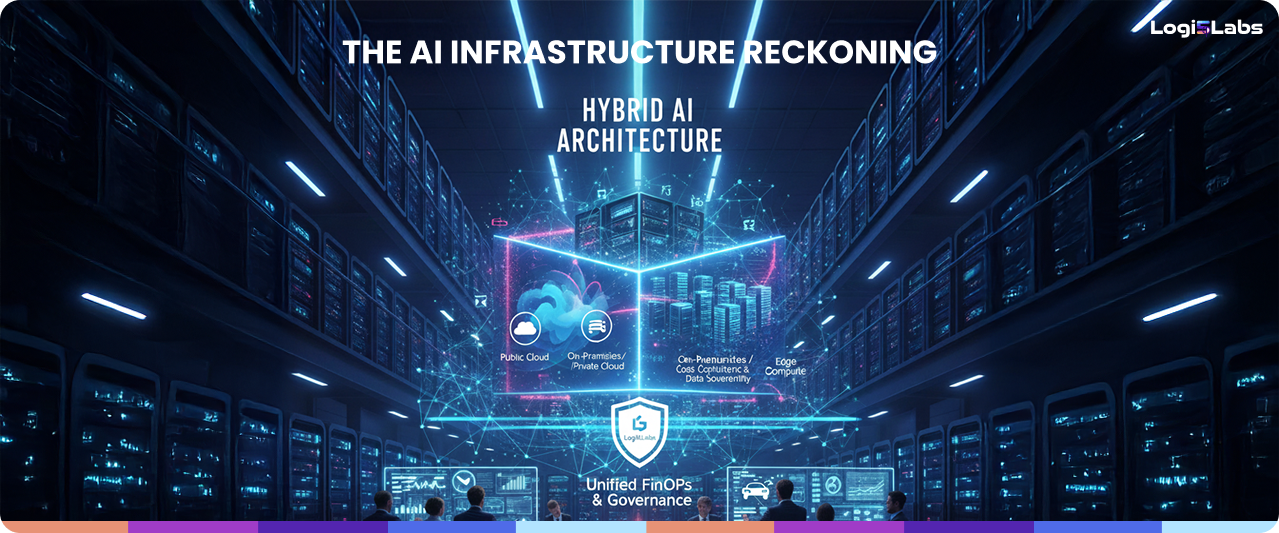
  II. The Strategic Mandate: The Hybrid AI Architecture The solution is not abandoning the cloud, but designing a smarter, Hybrid AI Strategy – one that places the workload on the optimal compute platform based on cost, latency, and compliance needs. This architecture requires clear, strategic segmentation of pillars, their workload focus, and business objective. For example, the pillar Public Cloud focuses on model training capacity to deliver fast, on-demand scaling and CapEx avoidance for peak loads. Likewise, the Private Data Center focuses on High-Volume Inference & Core AI Services to obtain Consistency & Cost Control leading to predictable expense and data sovereignty for stable, 24/7 autonomous agents. III. The Governance Problem: Why You Can’t Optimize What You Can’t Control This new architectural complexity creates an enormous parallel challenge: FinOps (Financial Operations) and Governance are now inseparable. You cannot effectively optimize cost or performance without a single, unifying intelligence layer. Organizations attempting to manage compliance and cost policies manually across different clouds, on-premises systems, and specialized silicon types are doomed to fail. This is the Governance Gap of the Hybrid AI Stack.   IV. Logi5Labs: The Orchestrator of the Hybrid Stack The solution lies in adopting a governance platform that transcends any single compute environment. Logi5Labs’ governance platform is the essential orchestrator of the Hybrid AI Stack. It provides the unified intelligence layer that links operational expense directly to compliance policy:
  • Unified FinOps and Governance: The platform enforces cost policies and compliance policies simultaneously. This includes automating the proper resource tagging (e.g., tagging resources as ‘Inference’ vs. ‘Training’) to ensure accurate cost allocation and rightsizing before the workload is deployed.
  • Data Sovereignty Assurance: The governance layer ensures that highly sensitive data is processed on-premises to meet regulatory requirements while simultaneously providing the full data lineage and audit trail across all environments, ensuring compliance is achieved without breaking the budget.

The companies that win the next decade will be those that treat the AI Infrastructure Reckoning not as a technical problem, but as the central financial and governance challenge of the modern enterprise.

Latest News

Let’s Create Your Next Big Video

Tell us what you’re planning — our team will map the fastest path from brief to feed.